

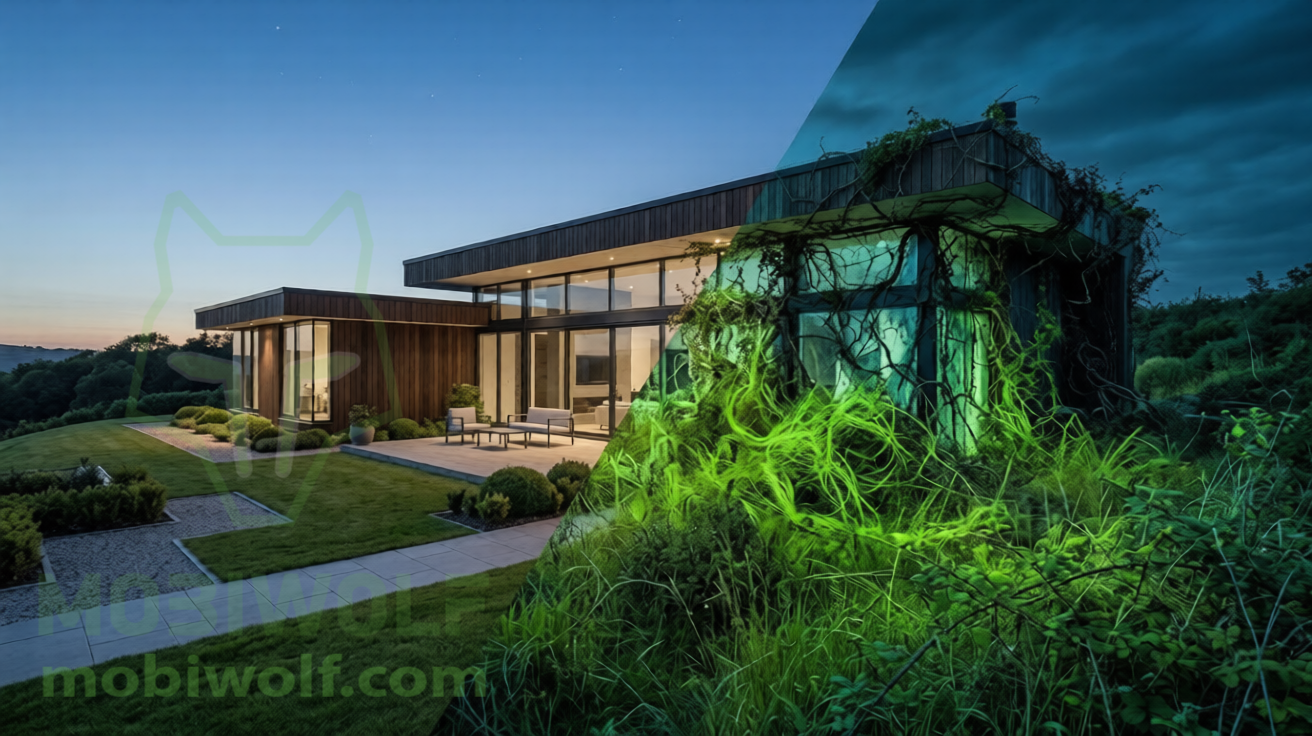
“An application is not a monument built of stone; it is a living organism that requires daily watering, pruning, and protection from the elements.”
When business owners launch a mobile or web application, they often share a common, comforting illusion. They picture their app as a finished brick-and-mortar building. Once the construction crews pack up their tools, the keys are turned over, and the roof is sealed, the job feels done. You expect to walk away, check in occasionally, and watch the investment stand strong for years without your constant intervention.
But anyone who owns a rural property or a country house knows the brutal truth of nature: if you leave a well-maintained plot of land alone for even four weeks, you won’t return to a pristine lawn. You will return to a chaotic jungle of waist-high weeds, clogged gutters, and a crumbling foundation.
In 2026, software development behaves exactly like that country house.
An application is a living ecosystem built on top of shifting sand. The moment you stop actively maintaining, updating, and weeding your codebase, a quiet process of technological decay begins. If you abandon your application for a month, it will not simply sit there waiting for you; it will slowly rust, break, and alienate your users.
The Illusion of “Done”: The Digital Wilderness Never Sleeps
The digital infrastructure your app relies on is constantly moving. Your software doesn’t exist in a vacuum; it sits within a massive, interconnected network of third-party tools, operating systems, security protocols, and device hardware.
When you build an app, you are essentially planting a manicured garden inside a wild, aggressive rainforest. The rainforest is always trying to reclaim the land.
-
The Shifting Ground (OS Updates)
Apple and Google update iOS and Android constantly. A security patch deployed by Google tomorrow can instantly break a critical Bluetooth Low Energy (BLE) integration or an API route that worked flawlessly yesterday. -
The Rotten Tooling (Third-Party Dependencies)
Modern apps are built using dozens of external libraries and frameworks. If a developer team stops updating these dependencies, they quickly become obsolete. What was a secure, modern piece of code six months ago turns into a flashing neon sign for hackers today. -
The Clogged Gutters (Data Bloat)
As real users interact with your system, they generate data, logs, and cache. Without routine cleanup, database queries slow down, server costs spike, and the user interface begins to stutter.
If your agency delivers an MVP and tells you, “It’s finished, you don’t need us anymore unless you want new features,” they are setting you up for a catastrophic collapse.
The Three Types of Digital Weeds Choking Your Product
Just like a garden has different types of invasive plants, an abandoned codebase develops specific, destructive problems that choke your product’s performance.

1. Technical Debt (The Creeping Ivy)
Technical debt is the ultimate weed. It starts small—a quick patch here, a skipped code review there, an unoptimized database query that “works for now.” If left unchecked, this debt wraps itself around your entire architecture. Within months, your system becomes so brittle that adding a single new feature requires rewriting three older modules just to keep the app from crashing.
2. Security Vulnerabilities (The Rot Under the Floorboards)
Hackers do not take vacations. New exploits and vulnerabilities are discovered daily. If your app’s server environment and API endpoints are not continuously monitored and patched, your users’ sensitive data is left exposed. A single data breach will cost you infinitely more in legal fees and lost trust than a year of proactive maintenance.
3. User Experience Decay (The Overgrown Path)
User expectations evolve rapidly. An onboarding flow or a payment gateway that felt smooth last year will feel clunky and outdated to a consumer today. If your competitors are continuously refining their apps while yours remains stagnant, your user acquisition costs will skyrocket as frustrated customers quietly delete your app.
Realities of Technical Maintenance and Scale
-
The Cost of Neglect
Industry data shows that waiting to fix a bug after an app has been abandoned for months costs up to 10 times more than fixing it during routine, weekly maintenance sprints. Neglect forces engineers to spend days re-learning the context of the codebase before they can even begin to repair the damage. -
The Lifecycle Paradox
On average, up to 20% to 25% of an application’s original codebase must be updated or refactored every single year just to keep the product functioning at baseline performance on newer devices and operating systems. -
The Server Efficiency Leak
Unmonitored cloud infrastructure can experience “resource leaks.” Abandoned processes and unoptimized databases can cause your monthly AWS or Google Cloud billing to increase by 30% to 50% without a single new user signing up.
The Mobiwolf Approach: Cultivating Sustainable Growth
At Mobiwolf, we do not view software development as a one-time transaction. We do not build an app, hand you the keys, and watch it get choked out by the digital wilderness. We build for longevity, and we manage your digital asset with the care of an expert supervisor.
-
Proactive Sprints over Reactive Panic
We don’t wait for your app to crash to fix it. Our teams employ systematic, ongoing maintenance intervals to update libraries, patch security loops, and optimize database calls before they ever impact your bottom line. -
Lean Architecture Built to Last
We write clean, modular code that resists technical debt. By utilizing advanced development frameworks and hyper-automated testing scripts, we ensure your app’s foundation is built to withstand market shifts without requiring a total demolition down the road. -
Transparent Health Metrics
You will never be left guessing what is happening under the hood. We provide clear, digestible breakdowns of your system’s performance, library stability, and server efficiency, ensuring your investment remains highly competitive and fully optimized.
Is Your App Currently Overgrowing? The 3-Point Audit

If you haven’t touched your application’s repository or infrastructure in over a month, take a look at these warning signs to see if the weeds are taking over:
-
Loading Times are Creeping Up
If your app takes two seconds longer to launch or process a screen transition than it did three months ago, your database is likely bloated and needs immediate optimization. -
An Influx of Vague Customer Support Tickets
When users start complaining about random freezes, failed logins, or buttons not responding after they updated their phones, your app is suffering from OS compatibility friction. -
The Original Developers Have Vanished
If the agency or freelancers who built your product are no longer monitoring the code, your institutional knowledge is actively evaporating, making future updates significantly more expensive.
Moving Beyond the “Build and Abandon” Mindset
To succeed in the modern market, business leaders must abandon the outdated mindset that software is a static product. Your application is an evolving strategic asset. Treating it like a physical building leads directly to mediocrity, technical debt, and financial loss.
When you embrace the operational reality that software requires consistent cultivation, the conversation changes. You stop asking, “When will this project be completely finished?” and start asking, “How can we keep this ecosystem optimized to drive the highest possible ROI week after week?”
Massive teams and bloated development hours won’t save an abandoned product. Surgical precision, continuous micro-updates, and a dedicated technology partner will. Do not let your hard-earned capital get buried under a jungle of unoptimized code.
Efficiency Blueprint: Static Projects vs. Cultivated Ecosystems
To visualize how these two mindsets impact your business performance, consider the stark operational differences between abandoning your technology and actively maintaining it:
| Dimension | The “Build and Abandon” Model | The Cultivated Ecosystem Model (Mobiwolf Standard) |
| Operational Philosophy | Treats software as a static, one-time purchase. | Treats software as a living, evolving strategic asset. |
| Response to OS Updates | Reactive panic. The app breaks on new phones, forcing emergency fixes. | Proactive adaptation. The code is updated smoothly before new OS versions launch. |
| Security Posture | Brittle and exposed. Third-party libraries slowly rot, creating data risks. | Fortified. Continuous patching and security updates protect user data. |
| Long-Term Cost | Extremely high. Neglect forces a costly, total rewrite every two years. | Highly predictable. Small, manageable maintenance intervals maximize your initial ROI. |
| Codebase Health | Suffocated by technical debt, spaghetti code, and database bloat. | Clean, modular, and optimized for rapid future feature deployment. |
| Market Competitiveness | Stagnant. The product quickly feels dated and loses users to faster rivals. | Agile. The app remains lightning-fast, secure, and ready to capture market opportunities. |
Protect Your Investment Today
Your application represents your vision, your strategy, and your capital. Do not allow it to be reclaimed by the digital wilderness. If your product has been sitting unmonitored, or if you want to ensure your upcoming launch is built on a sustainable foundation that won’t overgrow, let’s take control of your architecture together.
Contact Mobiwolf today for a comprehensive Technical Health Assessment. Our expert engineers will audit your codebase, clear out the technical debt, and design a lean, continuous maintenance strategy that keeps your application running at peak efficiency. Let’s get out of the courtroom of emergency bug-fixing and into the app store with a polished, dominant product.
Conclusion: Cultivating Long-Term Digital Dominance
The parallel between an overgrown country house and an abandoned codebase highlights a critical truth for modern business leaders: in the digital landscape of 2026, stability is an illusion. Software is never truly “finished.” It is either actively evolving to meet market demands, or it is actively decaying under the weight of shifting operating systems, security threats, and accumulating technical debt.
Treating your application as a static, one-time purchase is the fastest way to turn a valuable business asset into a financial sinkhole. When you neglect the continuous upkeep your infrastructure requires, you aren’t saving money—you are simply deferring a much larger, more painful invoice down the road. The true cost of software ownership isn’t just the capital spent to reach the initial launch; it is the strategic discipline required to keep that product sharp, secure, and highly competitive week after week.
Succeeding in this ecosystem does not require throwing massive development teams or endless billable hours at the problem. It requires surgical precision, proactive micro-updates, and an elite engineering partner who understands the direct relationship between code quality and business ROI. By shifting your mindset from “project completion” to “ecosystem cultivation,” you protect your initial investment, eliminate operational panic, and ensure your product is always structurally prepared to capture new market opportunities.
Do not let the digital wilderness bury your vision. Give your application the expert maintenance it needs to survive, scale, and dominate the market for years to come.