

“A bad system will beat a good person every time.” — W. Edwards Deming
Every CEO wants the next “Uber-like” experience for their clients. We obsess over pixel-perfect UIs and frictionless checkouts on the front end. Meanwhile, the back office is burning cash.
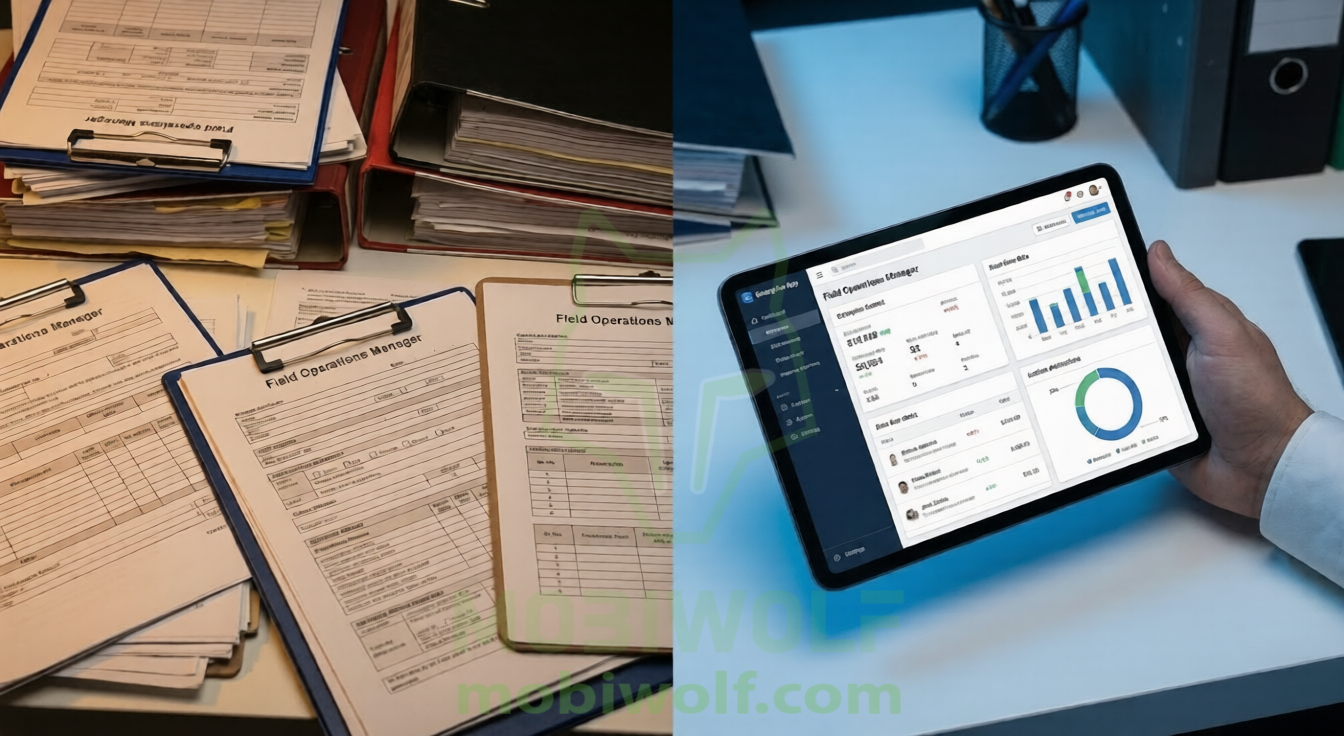
Your field technicians are still deciphering handwritten forms on clipboards. Your warehouse managers are manually re-typing data from paper to Excel at the end of an 8-hour shift. Your sales reps are navigating five different disconnected systems just to generate a quote.
This is the “Hidden Factory.” It’s the invisible friction that silently eats up to 30% of your operational efficiency every single day.
The Death by a Thousand Paper Cuts
The problem isn’t one massive failure; it’s thousands of tiny inefficiencies stacked together. Consider your field technicians, delivery drivers, sales representatives, or facility managers. How do they receive tasks? How do they report issues? How do they validate their work?
In 2026, far too many businesses rely on a fragile ecosystem of Excel spreadsheets, messy paper forms on clipboards, and endless chaotic WhatsApp groups.

Every minute a skilled technician spends deciphering bad handwriting or walking back to the office to file a report is a minute they are not doing the job you hired them for. This is the “Hidden Factory,” and it’s bleeding your profits.
The B2E Revolution: It’s Not About “Apps,” It’s About Workflows
While the tech world obsesses over B2C (Business-to-Consumer) startups, a quieter, infinitely more profitable revolution is happening in the B2E (Business-to-Employee) sector. If your operations rely on a chaotic mix of Excel spreadsheets, crumpled paper forms, and frantic Viber or WhatsApp groups, you aren’t just experiencing growing pains. You are actively hemorrhaging roughly 30% of your potential efficiency every single day.
A Business-to-Employee (B2E) application is not just a digital version of a paper form. It is a rethinking of the entire job process.
Instead of a clipboard and a radio, a field engineer has a tablet that guides them through a complex repair, shows them the exact schematic they need, and lets them order a spare part with a single tap. The data is validated instantly—no more “Is that a 5 or an S?”—and is immediately available to management.
The Warehouse Revolution
Imagine your warehouse environment. In the old system, pickers walk around with clipboards. Mistakes happen. Inventory counts are updated hours, sometimes days, after the stock has actually moved. Items are “lost” because someone forgot to write down a location change.
Now, imagine a ruggedized Android device or even a standard smartphone in the hands of every staff member. The B2E app connects directly to your central inventory system. The worker doesn’t read a picklist; they scan a location barcode. The app tells them exactly what to pick. They scan the item. The system confirms it instantly. If the wrong item is scanned, the device vibrates and alerts them immediately—preventing a return before the product even leaves the dock.
The Field Service Transformation
Consider merchandisers checking stock levels in retail chains or technicians servicing equipment. The old way involves driving to a site, doing the work, filling out paperwork, and then driving back to the office to submit it.
With a B2E app, the workflow changes drastically. The employee arrives on site. The app uses GPS geofencing to automatically check them in, verifying they are actually where they are supposed to be. They are presented with a standardized digital checklist.
Do they need to report damaged goods? They take a photo directly within the app. The photo is automatically tagged with the time, date, GPS location, and associated job ID. They sign off on the screen. Upon hitting “Submit,” the data is instantly available to the head office. Invoices can be triggered immediately. The operational cycle shrinks from days to minutes.

The “Consumerization of IT”: Why Your Employees Hate Your Current Tools
Your employees use seamless, intuitive apps like Instagram and Revolut in their personal lives. When they come to work and are forced to use clunky, slow, grey-screen enterprise software, they don’t just get frustrated—they find workarounds. They use their personal phones to take photos, send data via insecure chat apps, and create “shadow IT” that puts your company at risk.
A successful B2E app must be built with the same level of care for user experience (UX) as a consumer app. It needs to be fast, intuitive, and genuinely helpful. The goal is to make the “right way” of doing the job also the “easiest way.”
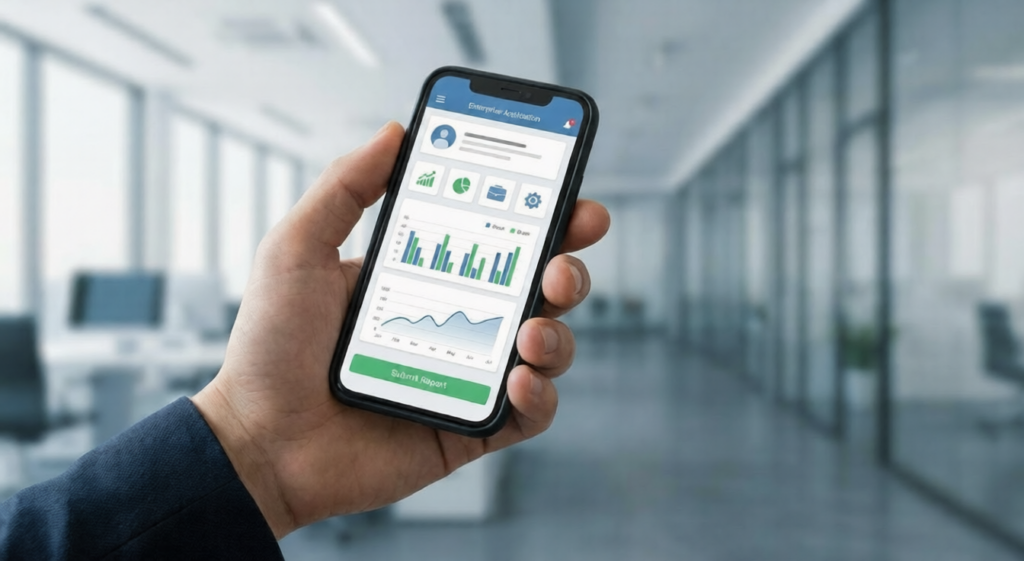
When you give your team a tool they actually enjoy using, compliance goes up, errors go down, and you finally get real-time visibility into your operations. The image below represents the ideal state: an employee seamlessly interacting with a modern, well-designed enterprise application.
Where the 30% Efficiency Returns From
When you ask where this magical “30% efficiency gain” figure comes from, it is rarely one single thing. It is the cumulative effect of removing dozens of micro-frictions.
- Elimination of double-data entry: Information is entered once, at the source, and flows everywhere.
- Reduced Rework: Catching an error at the moment of entry (via validation rules) is 10x cheaper than fixing it later.
- Faster Onboarding: When the process is baked into the app interface, you don’t need weeks of training. The app guides the new hire through the workflow.
- Real-time Intelligence: Management sees real-time dashboards of operational reality, rather than waiting for end-of-week reports that are already obsolete.
An internal app is an investment in operational hygiene. It cleans up the mess that slows you down and allows your team to focus on growth rather than survival.
Conclusion: Stop Ignoring Your Most Important Users
Investing in a B2E app is not an “IT project”; it’s an operational strategy. The ROI is measured not in “downloads” or “likes,” but in man-hours saved, errors reduced, and faster delivery times. By digitizing your “Hidden Factory,” you can unlock a level of efficiency that a customer-facing app could never achieve.
The market is crowded with companies fighting for customers. The real competitive advantage lies in empowering your own people with the tools they deserve.
BONUS SECTION: The 5-Minute “Hidden Factory” Self-Audit
You don’t need an expensive consultant to find the first signs of inefficiency. Take a walk through your warehouse, ride along with a field technician, or sit with your back-office team for just ten minutes today.
Look for these four red flags. If you spot even one, your operations are leaking money.
✅ The Clipboard Test: Are critical processes—safety inspections, delivery confirmations, inventory counts—still relying on physical paper and pen?
✅ The “Double Data Entry” Trap: Are your highly-paid employees writing information down in the field, only to spend the last hour of their shift manually typing the exact same data into a computer?
✅ The WhatsApp Spiderweb: Is official business—urgent issue reporting, shift changes, or task assignments—happening in chaotic, unmanaged personal chat groups instead of a dedicated professional system?
✅ The “Black Box” Delay: Do managers have to wait until the end of the day (or tomorrow morning) to get a report on what actually happened in the field right now?
Did you check any of these boxes? If yes, the friction is real, and the ROI of fixing it is immense.
“If your customer experience looks like 2026, but your employee experience looks like 1996, the gap between the two is exactly where your profit margin is dying.”