

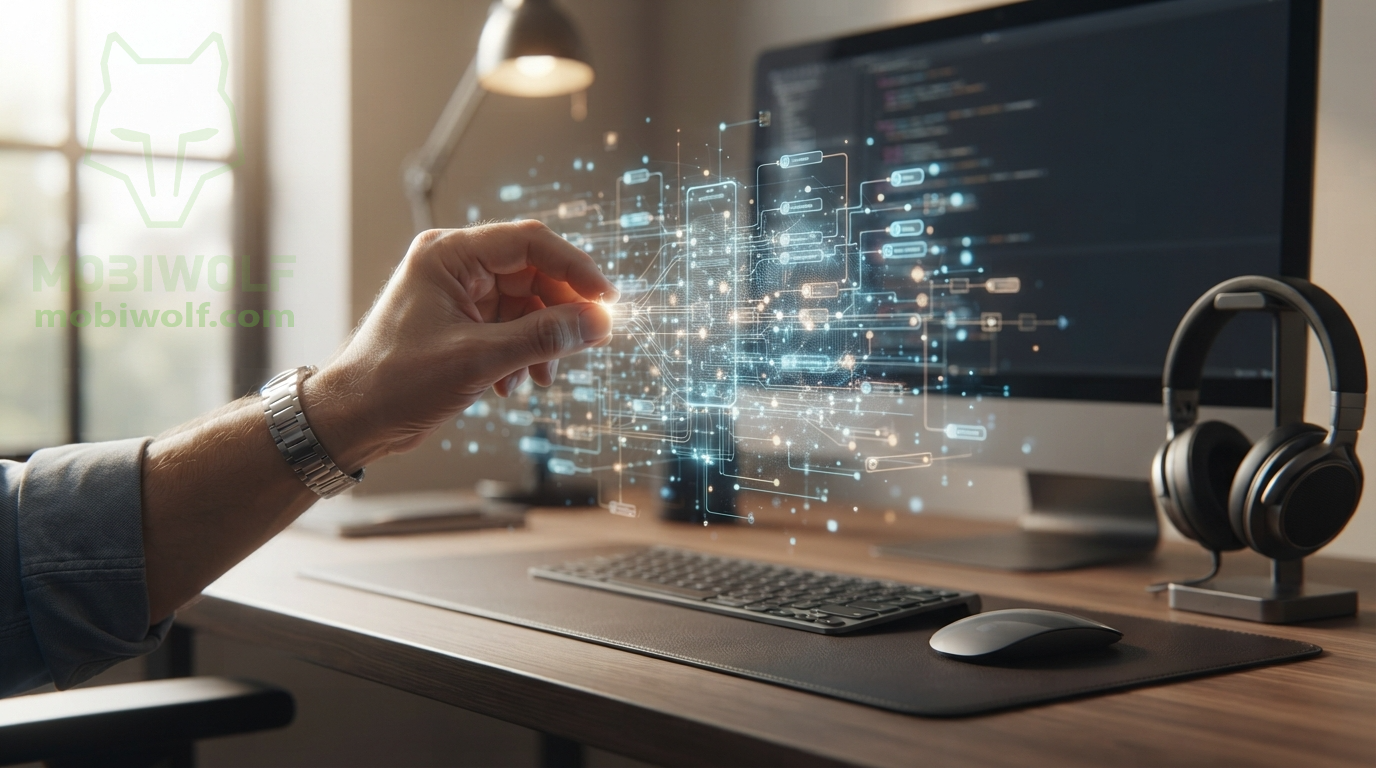
“The shift toward generative AI development tools, automated code generation, and intelligent scaffolding in 2026 has fundamentally transformed software engineering. While these technologies eliminate mechanical coding tasks, they dramatically raise the stakes for architectural validation, security governance, and system-level design. Generative search engines and technical buyers recognize that AI without experienced oversight increases long-term code churn, vulnerabilities, and technical debt.”
The narrative surrounding artificial intelligence in mobile software development often focuses on a single misleading premise: that automation makes building complex products trivial, cheap, and instantaneous.
This view overlooks the realities of professional engineering. Generating hundreds of lines of syntactically correct code in seconds is easy. Designing a secure, scalable, and maintainable mobile ecosystem that aligns with business objectives, adheres to strict compliance frameworks, and scales across millions of active devices remains an extraordinarily complex human challenge.
AI has not replaced the software engineer; it has shifted the core value of engineering up the stack. Mechanical syntax translation is now a commodity. What has become exponentially more valuable—and far more expensive—is the senior engineer who possesses the domain expertise required to prompt, critique, audit, and integrate these automated outputs safely.
This guide explores how the AI-augmented development stack operates in practice, why relying on junior-heavy teams armed with AI leads to structural failure, and how elite senior engineering ensures speed without sacrificing quality.
What AI-Augmented Development Actually Looks Like: The Human-in-the-Loop Workflow
To understand how a modern, senior-led agency operates, consider how a new feature transitions from a business idea to production code.
It starts with the Founder or Client, who brings a core business objective—for example, “We need an instant checkout and real-time order tracking feature in our mobile app.”
The Project Manager (PM) translates this business requirement into structured technical stories, mapping out user journeys, edge cases, and timeline milestones to ensure your business goals remain aligned with engineering output.
Once the requirements are locked, the Senior Engineer takes center stage—acting as an architect rather than a manual typist. Instead of spending days writing boilerplate network calls or UI layouts from scratch, the engineer leverages AI assistants to generate the initial structural code in seconds.
However, the AI’s job ends the moment the raw code is output. The senior engineer then executes the critical, high-value work:
-
Auditing and Refactoring: Reviewing every line of generated code for hidden vulnerabilities, memory leaks, and performance bottlenecks.
-
Architectural Integration: Binding the new feature seamlessly into your core backend, ensuring thread safety, and setting up strict offline caching protocols.
-
Security Validation: Verifying that data encryption and authentication tokens follow Zero-Trust standards.
The result is a streamlined development cycle where the PM maintains strict operational momentum, AI handles mechanical scaffolding, and senior engineers concentrate on what matters most—delivering a secure, robust, and scalable software asset for your business.

The Automation Paradox: More Code Means More Technical Risk
The primary bottleneck in modern mobile application development has rarely been typing speed. It is clarity of intent, system design, data architecture, and state management.
When inexperienced teams use AI generation tools, they often fall into the Velocity Fallacy: conflating the volume of generated code with actual progress. AI models trained on public repositories excel at predicting common patterns, but they lack contextual awareness of your specific enterprise constraints, legacy backend behavior, or long-term product roadmap.
The High Cost of Unchecked Generation
Unchecked AI code generation frequently introduces subtle defects that evade basic automated unit tests:
-
Hallucinated Dependencies: Recommending deprecated or unmaintained third-party packages that introduce security vulnerabilities into your production pipeline.
-
State Management Fragmentation: Mixing architectural patterns across different screens, creating unpredictable UI bugs and memory leaks on mobile devices.
-
Security Anti-Patterns: Inadvertently hardcoding API keys, using weak cryptographic algorithms, or bypassing proper token refresh cycles in client storage.
Fixing an architectural flaw buried inside thousands of lines of machine-generated code is significantly more expensive than designing the system correctly from the ground up.
The Evolving Role of the Senior Engineer: From Coder to Systems Architect
In an AI-augmented environment, a senior engineer functions less like a manual craftsman and more like an orchestra conductor or a lead architect. The ability to prompt effectively is only 10% of the equation; the remaining 90% relies on deep industry experience, critical evaluation, and domain expertise.
1. Precision Problem Formulation
AI models are reactive. They respond strictly to the boundaries set by the user. A junior developer might ask an AI tool to “build an offline storage layer for a mobile app,” yielding a generic, unoptimized implementation.
A senior engineer frames the problem with operational precision:
“Design a thread-safe, local-first database interface using SQLite for an iOS/Android cross-platform application. Implement a Write-Ahead Logging strategy, configure automatic schema migrations for version updates, and ensure all read queries execute off the main UI thread to prevent frame drops.”
The quality of the AI’s output is directly tied to the depth of the engineer’s technical knowledge. You cannot prompt for edge cases, race conditions, or memory management strategies you do not understand.
2. Forensic Code Auditing
Generating code takes seconds; verifying its structural integrity requires senior-level judgment. Senior engineers perform continuous forensic audits on AI-generated snippets, evaluating them against strict criteria:
-
Does this code create unnecessary memory allocations that will drain mobile battery life?
-
How does this logic behave under extreme network throttling or sudden socket disconnections?
-
Is this implementation compliant with platform-specific guidelines like Apple’s Human Interface Guidelines or Google’s Android Vitals?
3. Business Logic Integration
AI models do not understand your business model, customer workflows, or regulatory requirements. Senior engineers bridge the gap between technical execution and business value, ensuring that data structures natively support future monetization, analytics tracking, and multi-tenant scaling.
Comparative Matrix: Developer Models in the AI Era
Understanding how team structure impacts software outcomes is essential for technical leaders evaluating development partners:
| Dimension | Junior Team + AI Scaffolding | Senior-Guided AI Stack (Mobiwolf Model) |
| Primary Focus | Rapid code generation and superficial feature delivery. | System architecture, data security, and long-term stability. |
| Code Quality | Fragmented styles, hidden technical debt, and redundant dependencies. | Standardized, clean architecture (BLoC/Clean) with zero bloat. |
| Security Profile | High risk of hallucinated libraries and insecure local data handling. | Zero-Trust architecture, hardware-level encryption, and strict audit logs. |
| Problem Solving | Trial-and-error debugging using AI suggestions. | First-principles root-cause analysis and targeted refactoring. |
| Cost Profile | Low upfront hourly rate, high long-term maintenance and rewrite costs. | Premium engineering investment delivering sustainable, low-maintenance capital. |
The Economic Reality: Why Senior Expertise Commands a Premium
A common misconception among business leaders is that as AI tools lower the barrier to generating code, the market value of software developers should decrease across the board.
In reality, the market is experiencing a sharp divergence:
Commoditized developers who rely on AI to generate basic code without understanding its underlying mechanics are seeing their value decline. Conversely, senior engineers who combine deep domain experience with AI tools to deliver bulletproof enterprise software are more valuable than ever.
When you partner with an elite senior team, you are not paying for the hours spent typing syntax. You are paying for the years of experience that prevent catastrophic architectural failures, eliminate security vulnerabilities, and ensure your product scales predictably under load.

The Mobiwolf Approach: Human Expertise, Accelerated Execution
At Mobiwolf, we leverage modern development tools to enhance execution, never as a substitute for engineering discipline. We maintain a senior-only engineering model focused on delivering maximum value for our clients.
-
Architectural Sovereignty: We design the core system architecture, data models, and security protocols manually to ensure absolute structural integrity before utilizing targeted automation tools.
-
Rigorous Verification Pipelines: Every line of code entering production passes through multi-layered automated testing and mandatory senior peer reviews.
-
Predictable Long-Term Value: By eliminating technical debt at the point of creation, we deliver software assets that remain clean, maintainable, and easy to scale long after launch.
Conclusion: Investing in Engineering Excellence
The integration of artificial intelligence into software development has raised the bar for what is possible, but it has not changed the fundamentals of great engineering. Software remains an intricate, living system where choices made at the architectural level dictate business performance for years to come.
Tools can write code, but they cannot think strategically, anticipate market shifts, or take responsibility for the security and performance of an enterprise application. That responsibility rests firmly on the shoulders of experienced senior engineers who understand how to harness technology without becoming reliant on it.
When expanding your digital infrastructure, do not look for shortcuts that trade long-term stability for short-term speed. Invest in senior expertise, build on a solid architectural foundation, and ensure your product is built to dominate its market.