


“Design is often treated as a luxury for the young. But true innovation doesn’t care about the date on your birth certificate—it cares about the clarity of the solution. If your app makes a 70-year-old feel empowered, you’ve built a product that is truly universal.”
It was a Tuesday evening, and Arthur was trying to buy a plane ticket.
Arthur is 68. He is not “slow.” He ran a logistics company for thirty years. He managed hundreds of employees, navigated economic crises, and put three kids through college. He is sharp, solvent, and ready to spend $1,200 on a flight to visit his new granddaughter.
But Arthur is currently staring at his iPhone 15, his thumb hovering over a “Continue” button that is a pale grey on a white background. He taps it. Nothing happens. He taps it harder. The screen zooms in unexpectedly. A pop-up appears asking for a newsletter subscription, the “X” to close it so small it looks like a speck of dust.
Five minutes later, Arthur puts the phone down. He feels defeated. He feels old.
He doesn’t buy the ticket.
And you? You just lost a client who has more disposable income in his savings account than fifty Gen Z influencers combined.
This isn’t just Arthur’s problem. It is the single biggest blind spot in the modern tech industry. We call it the “Silver Economy,” but at Mobiwolf, we prefer to call it the Unclaimed Gold Rush.
The Silicon Valley Mirages
Walk into a typical design meeting in San Francisco, London, or Kyiv. Who do you see? Brilliant, energetic people. Average age: 26. They have perfect eyesight, steady hands, and thumbs that move across glass screens at the speed of light.
They design interfaces for themselves.
They create stunning, minimalist apps with thin fonts, gesture-based navigation, and hidden menus. They chase the “next billion users,” usually assuming those users are teenagers on TikTok.
Meanwhile, the data tells a brutally different story.
By 2030, the “Silver Economy”—the spending power of people over 60—will reach $15 trillion. This demographic holds the vast majority of the world’s private wealth. They are living longer, they are active, and they are desperate to use technology. They want to book tele-health appointments, manage their investments, order groceries, and video-call their families.
But we are locking them out.
The Art of Digital Empathy
When a 25-year-old user encounters a confusing app, they get annoyed and switch to a competitor. When a 70-year-old user encounters a confusing app, they blame themselves. They think, “I am too old for this.”
This is a tragedy. But for a business owner, it is a massive opportunity.
Imagine if your mobile product was the one that didn’t make Arthur feel stupid. Imagine if it was the one that made him feel powerful again.
At Mobiwolf, we have realized that designing for the “Silver Economy” isn’t just about making fonts bigger. That’s a crude, surface-level fix. It is about Cognitive Respect.
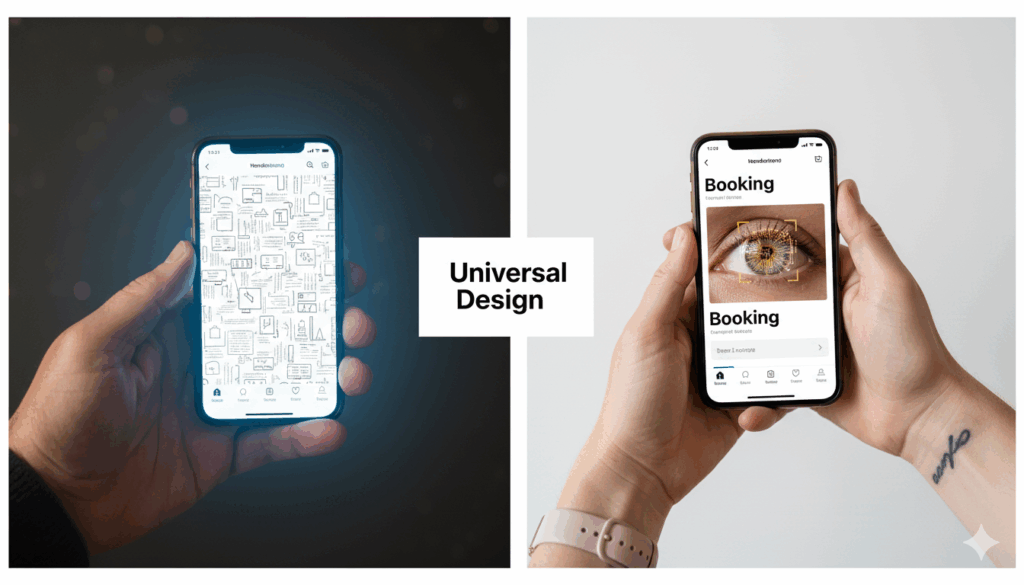
- It’s about Contrast: Eyes over 60 need three times more light to see as clearly as a 20-year-old. Why are we using light grey text on white backgrounds? Let’s use bold, high-contrast clarity.
- It’s about Confidence: Don’t hide the navigation. Don’t rely on swipes that require the dexterity of a surgeon. Give the user a button that looks like a button. Give them a “Back” arrow that is impossible to miss.
- It’s about Feedback: When Arthur taps a button, the phone should vibrate slightly or the button should change color instantly. He needs to know the machine heard him.
The Loyalty of the Wolf Pack
Here is the secret that growth hackers won’t tell you: The older generation is the most loyal customer base on the planet.
Younger users are fickle; they will delete your app because they didn’t like the color of the icon. But if you build a product that respects an older user—if you help them solve a problem without making them feel inadequate—they will never leave you. They will become evangelists. They will tell their friends at the golf club, the library, or the board meeting: “Use this one. It actually works.”
We are moving into an era where “User Experience” must evolve into “Human Experience.”
Your next big revenue stream isn’t hidden in a Metaverse avatar or a complex crypto-scheme. It is right here, in the hands of the people who actually have the money to pay for your services.
We just need to open the door for them.
At Mobiwolf, we don’t just write code; we bridge generations. We build technology that doesn’t discriminate.
Are you ready to stop chasing trends and start building for the masters of the economy?
The Myth of the “Senior Mode”: How to Please Everyone
A common question echoed in boardrooms is: “Should we build a separate ‘Lite’ version for older users?”
The answer is a resounding no.
Segregation in design is an insult. If you hand a user a version of your app that looks like it was made for a preschooler, they will feel patronized. Furthermore, if you optimize for seniors, you aren’t alienating Gen Z—you are actually delighting them.
Think about it. Who else, besides a 70-year-old, hates clutter, despises slow loading times, and wants to get things done with the fewest taps possible? A 20-year-old with a short attention span.
The secret isn’t “dumbing down”; it is “Progressive Disclosure.”
Let’s look at that airline ticket example again.
- ** The Old Way:** A screen cluttered with dates, insurance add-ons, seat selection, and luggage rules all at once. The senior gets overwhelmed; the student gets annoyed.
- The Universal Way: One question at a time.
- Screen 1: Where are you going? (Big text, voice input option).
- Screen 2: When? (A large, clear calendar).
- Screen 3: Pay. (Apple Pay / Google Pay).
This isn’t a “senior” interface. It’s a clean interface. It works for Arthur, and it works for his grandson who is booking a flight while sprinting to catch a bus. By reducing cognitive load, you increase conversion rates across the board.
Three “Invisible” Hacks You Can Deploy Today
You don’t need to rebuild your backend to make your app senior-friendly. Here are three technical “life hacks” our team at Mobiwolf often implements to solve these problems instantly:
- The “Fat Finger” Safety Net Motor control declines with age. Touching a 20-pixel icon is hard.
- The Fix: You don’t need to make the button ugly and huge. In the code, we simply increase the tappable area (hit slop) around the icon. The button looks elegant, but even if the user misses it by 5 millimeters, the app registers the tap. It feels like magic to them.
- Biometrics as the Ultimate Password Nothing kills a session faster for a senior than: “Please enter your password. It must contain a capital letter, a number, and a symbol.”
- The Fix: Aggressively implement FaceID and TouchID. For an older user, looking at their phone is intuitive. Typing “P@ssw0rd123” on a glass screen is torture. Make biometrics the default, not an option.
- The “Did I Do It?” Feedback Loop An older brain processes visual changes slightly slower. If they tap “Submit” and nothing happens for 0.5 seconds, they will tap it five more times, causing errors or double charges.
- The Fix: Instant Haptic Feedback. When a button is pressed, the phone should vibrate with a reassuring “click,” and the button should instantly change state (e.g., turn green or show a spinner). This tactile confirmation bridges the gap between the digital and physical worlds.
The Unclaimed Territories: Blue Ocean Ideas for 2025
If you are an entrepreneur looking for a pivot, or a business owner looking to expand, here are three niche concepts Mobiwolf has identified as massive “Blue Ocean” opportunities in the Silver Economy:
- The “Digital Executor” (FinTech / LegalTech) Arthur has crypto wallets, cloud photos, and bank passwords. What happens if he passes away?
- The Idea: A secure, encrypted “Dead Man’s Switch” app. It allows seniors to organize their digital legacy. If they don’t check in for a set period, the app automatically releases specific passwords and files to designated beneficiaries. It’s peace of mind as a service.
- The “Plain English” Medical Translator (MedTech + AI) Doctors’ letters and test results are written in Latin and jargon. Seniors receive them and panic.
- The Idea: An app where a user takes a photo of their medical document, and an AI (tuned for empathy and accuracy) rewrites it into simple, comforting language, highlighting only what they actually need to do next.
- Voice-First Smart Home Controller Smart homes are great for seniors (no getting up to turn off lights), but apps like Google Home are too complex to set up.
- The Idea: A simplified “Command Center” app that acts as a wrapper for IoT devices. No menus. Just a giant microphone button. “App, turn up the heat” or “App, lock the front door.” It’s not about tech; it’s about independence.